As networks grow more complex, spanning fibre, radio, cloud, edge and applications, human-led management no longer scales. AI is increasingly used to automate decision-making, manage energy use, optimise performance and support resilience. The result is not just faster connectivity, but a shift towards ‘thinking infrastructure’.
A digital publication from Bristol Innovations, University of Bristol
An introduction by Dr. Doug Pulley
CTO, RANsemi
Artificial intelligence in telecoms is not one thing. It never has been. Long before generative AI captured the world’s imagination, operators quietly used machine learning: they optimised routing, predicted faults, and automated the mundane. That history matters. One persistent tension in this industry is the gap between conversation and reality: capabilities announced at conferences often differ from features in live production networks.[1] That gap is wider than the industry likes to admit. Closing it is the real work of this decade.
Signals from MWC Barcelona 2026 and other major gatherings earlier this year were nonetheless directional.[2] Three AI themes dominated. First, agentic AI refers to systems that act autonomously, not merely following instructions, and can orchestrate network resources and personalise services in real time.[3] Second, the evolving family of approaches to AI in and around the radio access network. These are not one trend but several, with distinct actors and commercial drivers. Optimising the RAN from above is a near-term play. Embedding AI into the RAN architecture requires new silicon and new commercial relationships.[4] Designing an AI-native air interface is largely a 6G conversation that lies ahead.[5] Third, AI-powered digital twins enable network planning and fault analysis with a fidelity previously impractical.[6]
This report reflects the full breadth of that landscape. It is a broad church – deliberately wide in scope, spanning classical optimisation within network functions, large foundation models for customer experience, silicon-level inference, and the emerging discipline of explainability by design.
The implications reach well beyond the operator. For end customers, AI in the network means faster, more responsive and more personalised connectivity. For the industries that rely on that connectivity (from manufacturing and healthcare to logistics and public services), it means infrastructure that adapts in real time. For operators, the focus has shifted from whether AI can do something useful to how it can be governed, trusted, and scaled. That means confronting hard realities: training and inference demand enormous compute, which costs money and burns energy, and any system deployed in a critical network needs to be explainable, not just effective.[7]
If the industry gets this right, the prize is significant. Mobile technologies already contribute over 7.6 trillion dollars in economic value annually.[8] If telcos can harness AI as both an operational tool and a platform for the industries and consumers they serve, the downstream effects could be transformative. These effects on productivity, inclusion, and growth could be profound.
None of this will happen through individual effort alone. The GSMA’s launch of Open Telco AI at MWC26 points in the right direction.[9] Sustained progress, however, requires collaboration across the whole ecosystem. Startups bring fresh thinking. Established vendors bring scale. Operators bring network knowledge. Academia brings rigour. Governments and regulators create the conditions for responsible innovation to move at speed. The voices gathered in this report represent many points on that map.
References
[1] Fierce Network — MWC 2026 Complete Coverage (Microsoft Telco CTO: AI anomaly detection use cases haven’t panned out as expected)
[2] Light Reading — What will be the big themes at MWC 2026?
[3] Counterpoint Research — Key Themes at MWC 2026: Agentic AI, Automation and Semiconductors
[4] NVIDIA at MWC Barcelona 2026 — AI-RAN, operator partnerships and accelerated computing
[5] Light Reading — What will be the big themes at MWC 2026? (6G / AI-native air interface)
[6] Light Reading — What will be the big themes at MWC 2026? (AI-powered digital twins)
[7] Digital Applied — MWC 2026 AI Roundup: 10 Biggest Announcements (compute costs, energy, explainability)
[8] GSMA — Mobile Economy 2026 report / MWC26 opening press release ($7.6 trillion economic value)
[9] TechAfrica News — MWC Barcelona Day 1: The IO Era Arrives (GSMA Open Telco AI launch)
Upcoming Event
A panel discussion exploring how AI is transforming network management, where it has delivered measurable benefits versus remaining experimental, and what happens to accountability when automated systems make critical decisions.
Hosted by Bristol Innovations
Register on Eventbrite| Domain / Network Layer | Role of AI | Market / Industry Opportunity | Constraint / Risk to Watch |
|---|---|---|---|
| Network Operations (NOC) | Automated fault detection, predictive maintenance, traffic optimisation | Reduced OPEX for operators; managed network services for enterprises | Model sprawl; unclear accountability for automated decisions |
| Radio Access Network (RAN) | AI-driven spectrum allocation, beamforming, traffic balancing | Capacity gains without proportional hardware expansion | Energy consumption from distributed AI models |
| Core Network & Orchestration | Real-time resource allocation, slice management, service prioritisation | Enterprise 5G/6G services; low-latency industrial applications | Cross-domain optimisation conflicts (performance vs cost vs energy) |
| Edge Computing | AI inference at edge for latency-sensitive services | Smart cities, autonomous systems, industrial IoT | Infrastructure duplication; compute-energy trade-offs |
| Energy Management | AI optimisation of power usage across radio, fibre and compute | Lower operating costs; net-zero compliance; green spectrum strategy | AI workloads themselves increase power draw |
| Security & Resilience | Anomaly detection, threat prediction, automated response | Critical national infrastructure protection; defence and government networks | Governance, explainability and trust requirements |
| Integrated Sensing (6G direction) | AI interpretation of network signals for localisation and environmental sensing | Transport, safety, logistics, urban monitoring | Privacy concerns; regulatory uncertainty |
| Quantum-Secure Integration | AI-assisted optimisation of hybrid classical–quantum security layers | Government, defence, high-security enterprise markets | Deployment complexity; standards fragmentation |
| AI Infrastructure / “AI Factories” | Dedicated compute for model training and orchestration | New operator–cloud partnerships; infrastructure monetisation | Blurring of telecoms vs cloud business models |
| Sovereign & National Networks | AI-enabled traffic management within jurisdictional boundaries | Public sector procurement; sovereign cloud integration | Geopolitical fragmentation; interoperability risk |
Sources: Smart Internet Lab (University of Bristol); PwC Global Telecom Outlook; techUK (AI in telecoms consultation); Cambridge Consultants; Nokia Bell Labs; BI Foresight reporting 2025–26.
Telcos are buckling under the weight of multiple difficulties, all of which are applying downward pressure on their profitability. Their troubles include:
Meanwhile shareholders are demanding higher returns, consumers expect better services, and regulatory scrutiny is evolving and intensifying in areas like privacy, resilience and sustainability.
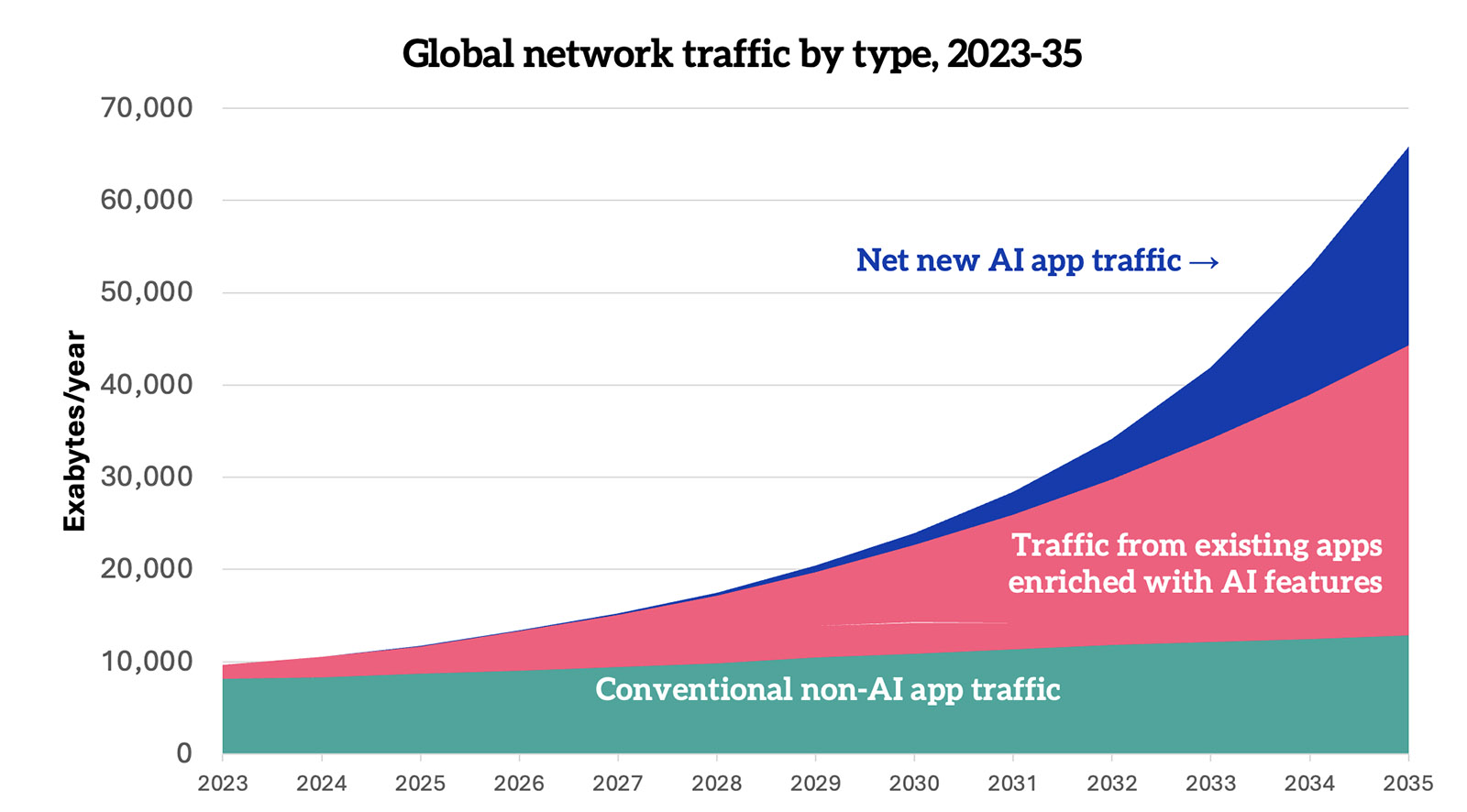
Networks are getting more expensive to manage and maintain. The World Economic Forum has projected that the basic running costs of a typical network will account for around half of total service provider OPEX by 2027. While this is in part down to unprecedented growth in data traffic, the real killer is the sheer complexity of managing modern networks, along with the need integrate diverse technologies ranging from edge compute to machine learning while eking out energy-hungry legacy infrastructure.
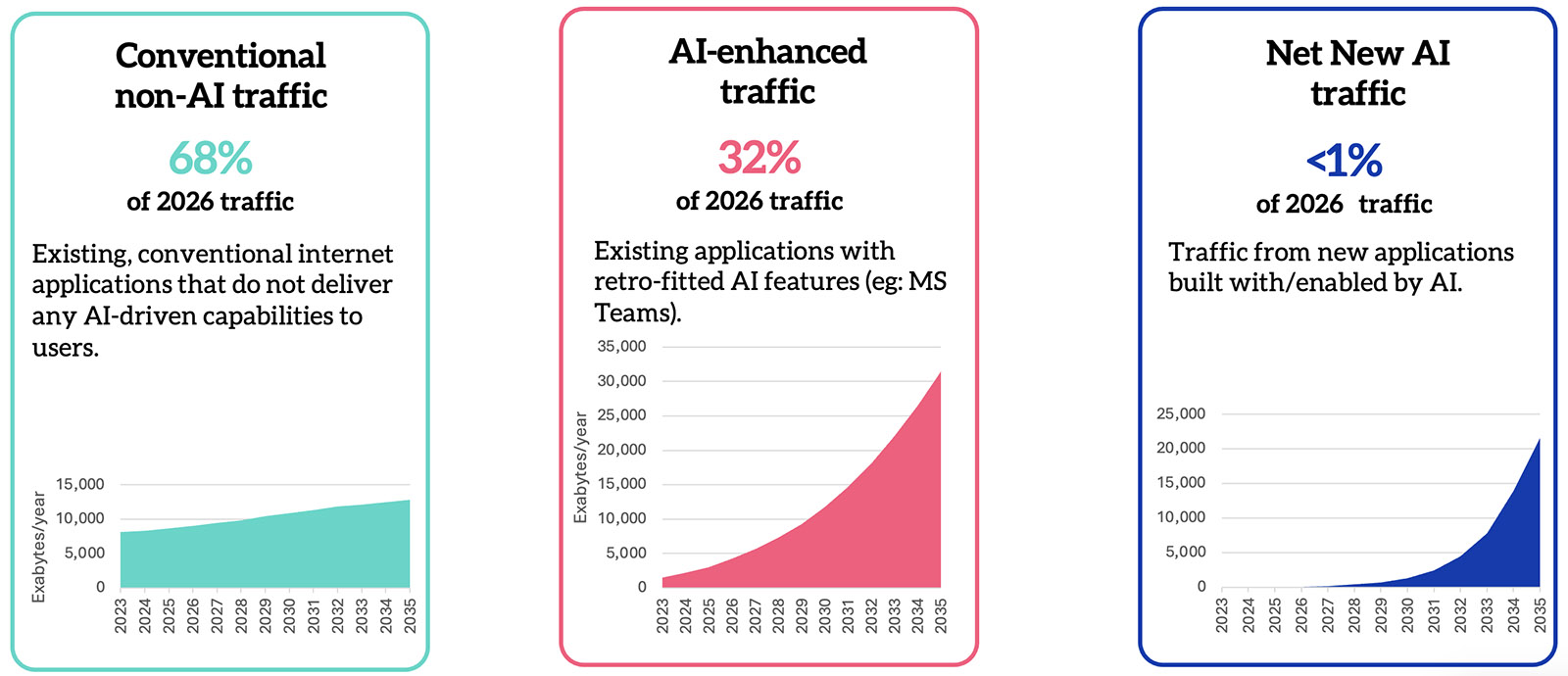
Source: Omdia. Analyst: Brian Washburn
Then there’s security. As critical national infrastructure, telcos face heightened cyberattack risks, with an EY report estimating that 57% of all DDoS attacks in 2024 specifically targeted them as primary vector. There is a grave shortage of professionals qualified to deal with issues like cyber risk. In fact there’s a talent drought affecting just about every area of managing a telco business. Difficult economic headwinds have in any case compelled many to put a freeze on hiring in new expertise.
These problems taken together mean that telcos are failing to enjoy the revitalising benefits of new technologies like 5G standalone and Open RAN, leaving them struggling to provide digital experiences more compelling than those offered by digital rivals. Many are looking at declining Net Promoter Scores (NPS) in consequence.
These myriad challenges are, between them, exposing the limits of traditional approaches to running a telco business. AI is emerging as a potentially game changing weapon here. From AI-enabled customer experiences to easier identification of cyberthreats to the automation of network management, AI promises to help burnish flagging profitability, offset the shortage of experienced personnel and fast track new streams of revenue.
But how to get to there from here? Telcos must start by moving on from defining themselves primarily as owners and operators of infrastructure and sellers of network access in favour of something much more software-driven and automated. On one level that means embracing platform-based services and network-as-a-service (NaaS) models. And that kind of transformation isn’t going to happen with unaided human-led network management.
The multiple emerging use cases for AI can, if appropriately integrated, help telcos move on from reliance on traditional connectivity and reposition themselves as so-called ‘techcos’ – agile, energy-efficient and streamlined deliverers of automated digital services and enhanced customer experiences. AI will deliver here by enabling the kind of living, breathing network fabric that can power a range of future connectivity use cases.
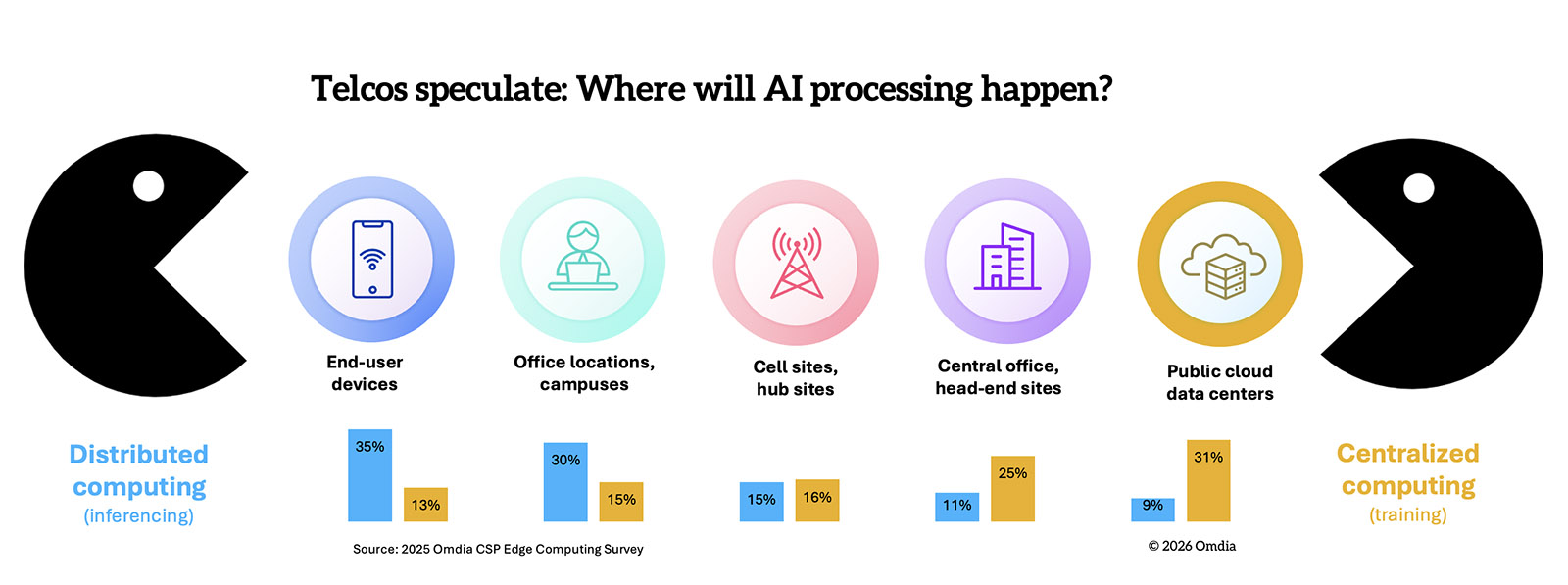
It is worth remembering that the relationship is a two-way street: “Telecoms needs AI, for sure,” believes Manish Gulyani, VP of Technology Marketing at Nokia. “But let’s not forget that without telecoms, there is no AI. You need a network to connect the AI factories sitting in data centres, where the training happens, to users, where the inferencing takes place. Onramps, both mobile and fixed, are critical before you can start getting outcomes coming out of all these models.”
The use of AI in telecoms networks is not a novelty. It has become commonplace in roles like prediction of network behaviour and network optimisation. Its anomaly detection potential is useful for security purposes.
“A lot of the current focus on automation of networks and services relies to some degree on AI,” says Professor Dimitra Simeonidou, Director of Smart Internet Lab and the Founding Director of the Bristol Digital Futures Institute. “There’s very little about a network that doesn’t use AI, to some extent. You have got embedded AI controllers in everything from the RAN to the control and orchestration side. Does this mean that the whole system end to end is optimised by AI? No, not yet it doesn’t. What we have is a lot of different AI-optimised elements that sit side by side.”
The next step, she says, is better programmability so that these independent elements are underpinned by system-level AI across the whole network, on a global basis if needed.
Simeonidou says the possibility of network-wide AI has been proven by REASON [Realising Enabling Architectures and Solutions for Open Networks], a UK-based research project led by the University of Bristol’s Smart Internet Lab in partnership with academic and industry leaders. The project, which is now completed, involved vendors such as Samsung, Nokia and Ericsson, as well as carrier names like BT, Telefonica and Deutsche Telekom.
“Our aim was to shape the future of 6G telecommunications by pioneering AI-driven, open and interoperable network solutions,” she explains.
If there’s one area where AI can decisively move the needle then that’s network management. “Modern comms are insanely complicated,” points out Rupert Baines, serial entrepreneur and non-executive director at CSA Catapult. “Think about the amount of software that’s involved in a 5G stack - many millions of lines of code. All the different elements of the stack interact in sometimes unpredictable ways making it beyond humans to manage.”
Baines foresees that managing the protocol stacks for 5G, and soon 6G, will be done with AI micro agents inside the architecture to make things run better: “Think of them as little minions that operate inside the base station, optimising performance, identifying problems, sounding alarms,” says Baines. Deutsche Telekom, he points out, has tried something like this and measured a 20% to 30% improvement in efficiency. Rakuten has deployed micro agents in an Open RAN and recorded 17% energy savings. Nokia has been testing similar technology and reports 30% better performance, with 99% less human effort.
Baines believes that AI in a network management role doesn’t so much replace humans as make them a lot more efficient: “It delivers gains worth having in an industry where margins are tight,” he notes. “Think how much telcos spend on energy. A 20% AI-driven saving is huge.”
Kerem Arsal, Senior Principal Analyst with Omdia, observes that AI’s transformative power extends beyond connectivity: “Outside the network, the obvious application of AI today is in customer service and support,” he says. “Until a couple of years ago this was basically chatbots. Now it’s spreading into a lot of other areas, right up to financials where it’s assisting commercial leaders with important decisions.”
Arsal adds that it is now commonplace for telcos to deploy AI personal assistants to help employees with many functions, and that AI is used daily in cloud and IT operations, as well as sales and marketing and product development. It can help build a more personalised offer for a customer, understand buyer behaviour, and develop appropriate sales collateral.
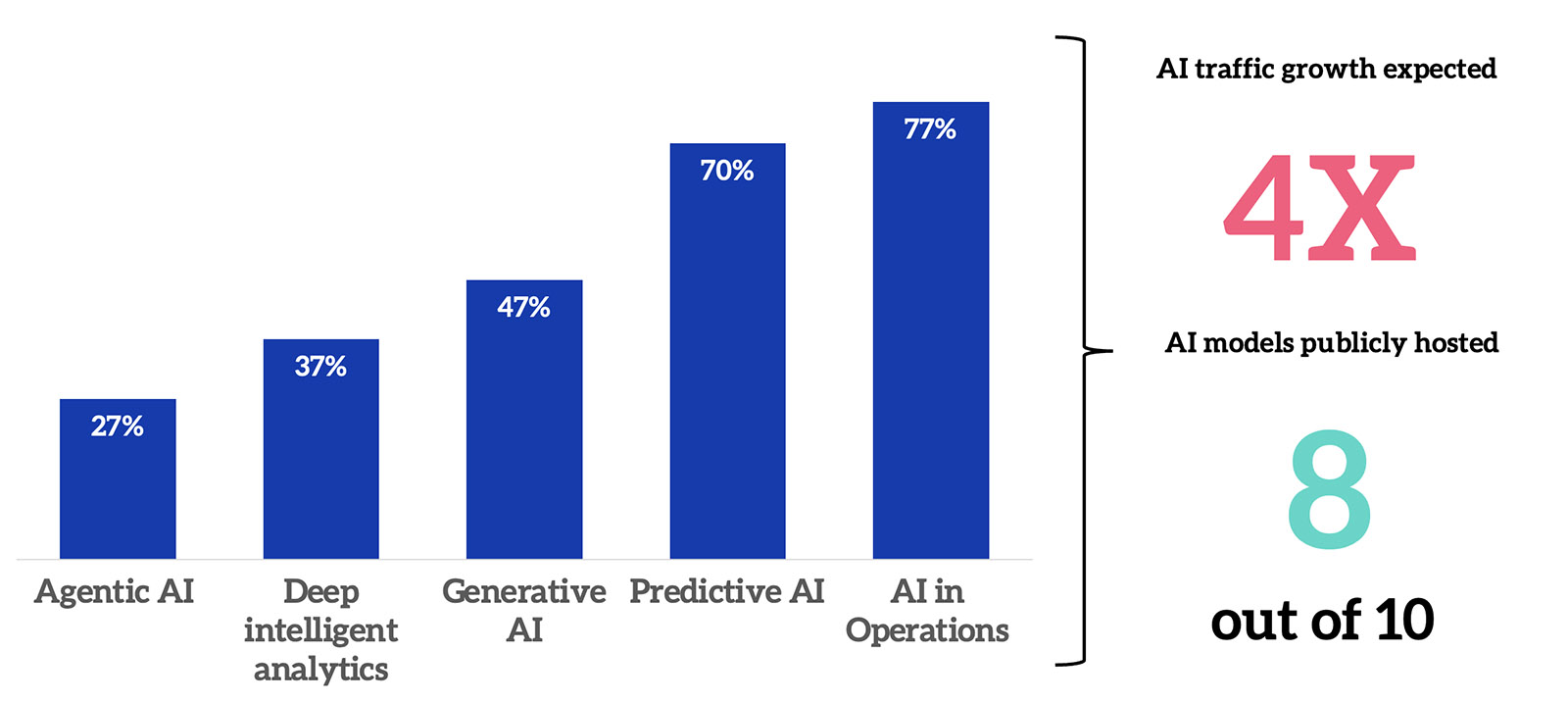
Note: Deployed may include one or several uses. Public includes in embedded 3rd party application, customizable / fully public AI. Expected traffic growth over the next 18 months. Average growth expectation compared to current. N=419. Source: Omdia 2025
But Arsal is certain that the next big wave of AI telecoms innovation and adoption will be deep in the network: “The next phase will go beyond the usual suspect applications like root cause analysis and anomaly detection,” he predicts. “We’re heading for more intelligent traffic routing, automated service provisioning and configuration, and better capacity planning and design. Energy saving will be another gain. If you use AI to put your RAN into idle mode you will notice immediate savings.”
Source: Omdia CSP Edge Computing Survey
The direction of travel is clearly taking us towards ‘thinking architecture’, powered by AI agents that are able to learn and improve with minimal supervision. We are not far from intent-driven networks where humans give direction to AI agents, including a mix of provisos, and let them figure out a way of getting there. Agents will play with billions of parameters to optimise what human overseers are asking for, talking amongst themselves at a high level.
Standing as we are on the cusp of 6G, it is already likely that this kind of intent-driven, semantic communications will really matter for its success. When we see the first 6G standards they will more than likely include this type of intelligence, along with distributed compute and autonomous testing.
This vision of a thinking network is not just about solving today’s problems, it’s about building an architecture for the future. The UK has an opportunity to be a leader in this field thanks to its rich mix of academic thought leadership, entrepreneurial ingenuity and track record in collaborating experimentally.
Working at the frontier of telecoms and AI? The Bristol Innovations Zone connects businesses with world-leading researchers to turn R&D ambitions into real outcomes. Find out how.
Explore BIZ
Nektaria Efthymiou
Network platform and security research director, BT Group
Efthymiou: There’s no doubt that networks have been getting more and more complex. This means we need to get better and faster at innovating to deal with that. In addition, the telecoms industry has matured and revenue growth is slowing. And because we are also talking about critical national infrastructure, we need better ways to provide resilience in those networks. Automation and AI help us with all of these things, allowing us to transform networks and drive performance and growth. It’s about more than just technology. We’re now talking about cross domain orchestration, and a whole new operating model. This demands a new mindset.
Efthymiou: Automation in networks is not new. Telcos have already identified many areas where it can be introduced in the interests of driving efficiencies. What has changed is that we are now seeing AI and automation used in a more holistic way, not just as isolated tools for network optimisation. The next step is for it to drive operations, deliver business agility, and enable the improvement of the customer experience. It provides a layer of flexibility and cross domain orchestration that can, for example, support network as a service (NaaS). It can act as the basis for new growth and new types of service.
Efthymiou: The biggest misconception is that AI will remove humans. It won’t. Humans will still set intent, policy and guard rails, and machines will execute on that. The other misconception is that we need more and more data and more compute to get results from AI. But studies have shown that we have actually reached a point of diminishing returns. You can’t increase performance just by putting more data into AI models. Eventually you start hitting some physical limitations as well as economic challenges, and pretty soon you find that the brute force approach of ‘faster, bigger’ is not delivering any more. The future may be more about smaller models that are specialised for particular tasks. We’re starting to hit some limitations too in terms of GPUs and memory. What we need are better ways of optimising AI architectures. That means not only scaling down with smaller, more specialised models but scaling out too with agents that interact.
Efthymiou: From the start, it was obvious that regulated, nationally critical infrastructure, where resilience is so important, would require AI to be explainable, auditable, and reversible. If you don’t have these things, then you can’t put it on a vital network like BT’s. Also, many networks around the world feature a lot of legacy elements. That can make it hard to move AI out of siloes and across domains, ensuring that decisions taken do not conflict. For the last 30 or 40 years, telecoms has operated networks with a certain set of rules, policies and frameworks, and now we need to change that and make sure that not only do we have the right technology in place but also the right mindset and operating model. This is hard to do, but not impossible.
Efthymiou: Energy and sustainability requirements make automation essential. We cannot fully optimise energy with static configurations. You can’t do it if you’re only changing configurations every so often. You need to make energy-related decisions in real time based on context and have dynamic control over how you optimise those networks. AI and automation become essential here, not optional.
Efthymiou: It’s not necessarily about ‘AI everywhere’. Success will be judged in terms of the outcomes that we can deliver. That will be in areas like faster delivery, lower energy use, better customer experiences. Can I improve my NPS, my OPEX? Can I integrate vendors better, and reduce time to detect and repair problems? Do I have a degree of flexibility and abstraction that lets me launch new services faster? Achieving all this means a combination of things, and AI and automation are tools that will help drive those benefits.
Efthymiou: When you put automation at the heart of the network, you extend the surface that adversaries can attack. This makes cybersecurity very important – more than just an over-the-top layer. My team is working on this, on how to create more adaptive security that is not simply reacting to a problem but helping to prevent it before it happens. This will become more important as we progress further with AI and automation in network operations.
Wayra, Telefónica’s venture and open innovation unit, backs startups developing technologies for telecoms and digital services, helping them scale through investment, industry expertise and access to Telefónica’s global infrastructure.
“There has been a definite uptick in the number of investment opportunities with AI central to the business model, so much so that this is now my sole focus. We are seeing both volume and maturity, with founders now typically pitching clear AI-driven workflows, unit-economics improvements or new product categories rather than just ‘we use AI somewhere in the stack’.
We’re seeing a lot of activity in particular areas, such as agentic AI with use cases around operations and back-office processes. We’re seeing it around predictive maintenance, self-optimising networks, anomaly detection and capacity planning. There’s AI-driven voice use cases too, especially around contact centres and customer service.
From our perspective, we’re looking for a high quality, financially-driven opportunity that can make a strong strategic impact across the Telefonica group. We look for clear impact and value for Telefonica, anything that can improve efficiencies, uplift revenue and improve customer service.
We’re seeing a lot of opportunities around AI security in areas such as AI-driven threat detection, anomaly detection in network traffic and fraud prevention. As for future AI use cases, I personally would like to see truly autonomous network operations especially around agentic systems that don’t just recommend actions but can safely execute end-to-end workflows with strong guardrails and observability.”
Madevo develops AI-driven software for telecom operators, enabling smarter network operations, automated optimisation and improved service performance through advanced data analytics and machine learning.
“Our core product is an agentic AI platform, a tool that allows companies to build and customise AI agents. We are integrating our platform with network operators and data centre infrastructure, providing agents that monitor the network. It analyses the data and finds solutions, in some cases solving problems itself. There’s still plenty of scepticism about AI, so we’re working with clients to build proofs of concept. We want to show how we’re focussing on operational complexity and cost. To maintain infrastructure you need troubleshooting, and the existing tools for that are very traditional. AI allows you to say ‘I want an agent that monitors network health’. You can delegate that to an agentic AI platform. That way you save time and money and improve network performance.
We’re on the journey towards ‘thinking architecture’, with several elements of that in the pipeline. At the moment we’re still in the phase where we’re still proving the concept. As we progress towards greater autonomy, I think we will always need humans in the loop, to be sure that everything is going well. But greater use of AI will certainly help to streamline operational teams and processes. We’re not at the stage yet where an agentic system can completely replace people.”
Nokia is a global supplier of telecom network infrastructure and software, working with operators to build and manage mobile, fixed and increasingly AI-driven communications networks worldwide.
“There’s a lot of excitement around agentic AI. At the recent MWC in Barcelona, Nokia was demonstrating how you can ask the network domain controller if there is an issue, and it will fire off an agent to find out what has happened and where. It almost thinks like a human, breaking the problem down as a flesh and blood agent would – reasoning, assessing, making recommendations. You can get to an assessment within seconds, not hours as before.
People are starting to see AI’s true potential. The next phase will be bringing it from PoC into production. It might take time for the industry to get comfortable with deploying agentic AI in particular. Autonomy is a much bigger step than mere automation. For true autonomy you need to be sure you have the right guardrails. You need confidence and trust in AI’s decisions. Humans must define the rules.
At Nokia we provide networking solutions all the way from the device in the home to the hyperscale cloud. But that’s just one bit of the puzzle. We participate heavily in the wider ecosystem, and the network is only a small part of that. For any kind of AI capability you also need compute, storage and applications. We showcased a solution at MWC with 25 partners – service providers, hyperscalers, system integrators.
Collaboration and joint innovation will be critical if we’re going to see the adoption of AI done in a cost efficient, secure and reliable way, respecting things like sovereignty and privacy as we go. For this, we must allow different people to bring their expertise into play.”
Professor Dimitra Simeonidou leads the Smart Internet Lab and founded the Bristol Digital Futures Institute, focusing on next-generation networks, 6G, optical infrastructure and the digital systems shaping future connectivity.
“With AI and telecoms, there are two aspects to bear in mind: AI for networks, and networks for AI. The second is probably gaining more attention at the moment. An important future for networks lies in enabling AI, helping to distribute AI resources and play a part in the improved utilisation of those resources.
Joint Open Infrastructure for Networks Research [JOINER] is an experimental platform demonstrating how this can work at scale. JOINER is a federation of more than 15 labs and test beds across the UK, led by the University of Bristol.
If you want to use network connectivity in a dynamic way, for example to provide SMEs with GPU resources they don’t otherwise have access to, you can only do this through advanced network infrastructure. JOINER connects GPU resources across all 15 of its widely distributed nodes.
The networks of the future will not just be there to provide connectivity but to broker AI resources for third party AI applications. This will transform the telco industry. For years telcos have been trying to dig themselves out of a hole where they are creating lots of infrastructure then struggling to find ways to monetise it through added value services. The value add service they have been waiting for is the dynamic connection of AI resources.
An example of this in action today is Deutsche Telekom which has launched an Nvidia-powered ‘AI factory’ at a data centre located in Munich’s Tucherpark.”
AI is already pervasive within the telco ecosystem, albeit on a piecemeal basis, helping to streamline certain functions and generate efficiencies. But no telco has yet trusted AI to operate a live network unaided. There are several reasons for that, not least the continued existence of huge reservoirs of legacy tech that inhibit easy automation. This isn’t disappearing any time soon, even with the best will in the world. A mass migration to new AI-native infrastructure would come at a high capital cost that operators aren’t rushing to commit to without a proven new business model attached.
The truth is that there are multiple micro-constraints slowing the deployment of AI in telecoms, some real and some a matter of perception. Let’s examine a few in more detail:
AI offers a clear opportunity for network optimization, but it is also creating more openings that criminals can exploit and that operators must defend. “AI is exposing new surfaces for security attacks,” believes Professor Dimitra Simeonidou, Director of Smart Internet Lab.
She points out that with AI can come other forms of risk that are off-putting to potential deployers: “If AI agents are given autonomy they might start to attack your network, and you have no way to predict this,” she says. “This is why AI isn’t allowed on live networks.”
The amount of energy consumed by deploying AI needs to be part of any cost benefit analysis. By launching AI, there is the possibility that you are immediately compromising your energy targets.
“Training and inference require huge amounts of compute which in turn costs a lot and burns a lot of energy,” observes Dr Doug Pulley, CTO of Bristol-based semiconductor company RANsemi. “A lot of the work we’re doing with SoC technology seeks to address this by adopting new approaches. You need continuous learning on local data so you don’t have constant tromboning across the network. You can’t keep traversing the network if you want high throughput and low latency.”
“The industry doesn’t have enough people who understand AI, let alone the intersection between AI and telecoms,” fears Rupert Baines, serial entrepreneur and non-executive director at the Compound Semiconductor Applications (CSA) Catapult. “In the UK we have a demographic crisis. Too many people in telecoms are over 50, and there are too few women going into the industry. Diversity is not there, and we need to solve that.”
Talent might be attracted if the industry were less fragmented, he feels: “We need a roadmap for AI in telecoms. There are great ideas, but many of them are siloed. We need somebody, perhaps at government level, to weave it all together.”
AI, like many innovative technologies before it, suffers from a gulf between what is talked about and what’s really going on, never more so than in networks. Much of what is being deployed right now amounts to supervised or reinforcement learning, but gets branded as ‘agentic AI’ because that’s the message of the moment that people want to hear. Little of the AI deployed in telecoms is in any way autonomous, in other words with no human in the loop. You have to look hard for use cases involving causal reasoning or continuous learning, while automation of known workflows and the identification of patterns in data are everywhere. This gap between reality and hype is probably compromising AI’s longer-term prospects by setting up inevitable disillusion.
There can be a gap between vendors keen for telcos to upgrade to new AI-enabled infrastructure, and telcos who would rather have a software bolt-on that works with their legacy infrastructure. The result can be hesitancy and uncertainty.
There are other cultural reasons for sticking to the slow lane: “Networks are critical assets, and highly regulated,” says Kerem Arsal, a Senior Principal Analyst with Omdia. “Telcos want to adopt AI, but they are also wary of flooding their networks with it without knowing more about the consequences. That’s why we’re seeing a lot of pilot modes and piecemeal implementations.”
AI, he says, demands proper champions at top level with a good grasp of how and why it is being adopted across the organisation and a notion of its risks. Only with this kind of cultural buy-in can AI’s very real challenges be faced, such as the risks inherent with allowing it into cloud-native architectures.
As AI continues to permeate deeper into the heart of telecoms, transforming operations, making networks more resilient and energy-aware and improving customer experiences, the conversation will inevitably need to move on from one of mere technical feasibility. Account is already starting to be taken at top level of issues like governance, ethics and accountability. Once we have true thinking architecture, capable of making its own operational decisions, what should we trust it to do on its own? When AI gets a call wrong, who has responsibility?
Telcos are already answerable to a range of parties in this area. Customers, suppliers, partners and shareholders will all want evidence that ethical, safe and appropriate use of AI is top of the governance checklist. Telecoms regulators are also watching with heavy penalties at their disposal for those who fall short.
Kerem Arsal, Senior Principal Analyst with independent consulting firm Omdia, believes that telcos may be better placed here than they imagine: “Compared to many other industries, telecoms has plenty of existing experience around trust, governance and accountability,” he believes. “They’re ahead of the curve here and preconditioned to be wary of regulation.” He believes that network operators should be seeing the governance and trust issue as more of an opportunity than a threat, a chance to be thought leaders and honest AI brokers, especially in the B2B market where customers may be in the early stages of evaluating its possibilities.
“If we’re going to get [AI governance] right, we need to be thinking about explainability,” says serial AI start-up entrepreneur Rupert Baines. “AI is already capable of doing things, with nobody quite sure why or how it did them. There was a recent chess game where AI beat a grandmaster with some unusual moves that no human would have thought of. Do we really want that power loose in the network, running policy and sounding alarms? If you don’t have explainability and accountability in an area like security, that’s a red flag. We need validation of AI-driven decisions at network scale.”
Daniel Dykes is Head of Product at Literal Labs, a spin-out of Newcastle University that uses logic-based techniques to generate custom AI models: “Standard neural networks are a bit of a black box when it comes to explainability,” he claims. “This gives rise to problems in industry sectors where trust matters. Our algorithm takes out all the complex matrix multiplication and replaces it with lots of logic.”
The result, he says, is an AI model that can make decisions and forecasts with maximum explainability and determinism – with none of the hallucinations that can plague AI outcomes on a neural network. And it uses about 50 times less energy than a network running on GPUs.
“Lots of highly regulated industries opt not to deploy AI in critical areas,” he notes. “I’ve heard this from banking, insurance, water utilities, energy. That’s because they need to be able to explain to their regulator what AI is doing with a very high degree of confidence. That’s difficult with a neural network, almost impossible in certain circumstances. A human-led bad decision will get them a small fine, while an AI-led mistake, without the benefit of native explainability, means a huge fine.”
A telco that understands what an AI model is going to do before they deploy can’t be described as ‘letting it loose on the network’. They can run multiple simulations before to sniff out anything that might go wrong. With fears of a rogue AI takeover put to bed, it becomes a matter of seeking out all the cost centres in a telco business and fearlessly applying AI to them. “This could start with optimised network performance, security and routine maintenance tasks,” says Dykes. “Eventually telcos will be creating digital twins of their network, with IoT sensors out in the field, so they can carry out predictive maintenance.”
AI gives telcos an opportunity to reinvent themselves, becoming model AI-native organizations and a template for others. With AI embedded everywhere they can kick start a new phase of growth following a period of soul searching and quiet decline in profitability.
It won’t however be possible for telcos to transform themselves into AI-native companies without a strong policy on responsible AI (RAI), the practice of deploying AI in ways that are ethical, safe, transparent, and compliant with regulations. Adhering to RAI frameworks that cover accountability and transparency will be central to gaining the trust of customers and other players in the telco supply chain. RAI isn’t just a theoretical ethical exercise, it’s a business imperative.
To assist its members, industry body the GSMA has circulated the first ever Responsible AI (RAI) Maturity Roadmap, providing network operators with the tools and guidance they need to test and assess where they currently stand with their responsible use of AI. The guidance was founded on research from independent consulting firm McKinsey which has estimated that expanded use of AI within the telecoms sector will be worth up to $680 billion over the next 20 years, if issues of governance can be resolved.
McKinsey describes RAI as a framework for designing, developing, and deploying AI systems in a transparent and accountable manner, ensuring AI aligns with human rights, societal values and legal regulations while minimizing risks like bias. Core principles include fairness, safety, security, privacy, and accountability.

The Bristol Innovations Zone (BIZ) is a gateway for collaboration between industry and the University of Bristol – giving businesses structured access to deep-tech research, specialist facilities and emerging talent. Whether you’re scaling an existing programme or exploring new directions, BIZ is built for partnerships like yours.